How to vet a halal food creator: the five checks that matter
Most restaurants judge a creator on follower count, which is the one number that tells you least. Here is what to check instead, with the actual thresholds, and the point at which a free meal legally becomes an advert.
By Abdirahman Mohamud, Founder, Rihla Reach · 25 August 2026
A creator with 8,000 followers can be worth more to a halal restaurant than one with 80,000, or worth nothing at all. The difference is not visible on the profile page, which is why so many restaurants end up comping meals for people who never post, or worse, for people whose last three posts were in a cocktail bar.
These are the five checks we run before booking anyone. They are ordered deliberately: the first one is a pass/fail gate, and there is no point running the other four until it clears.
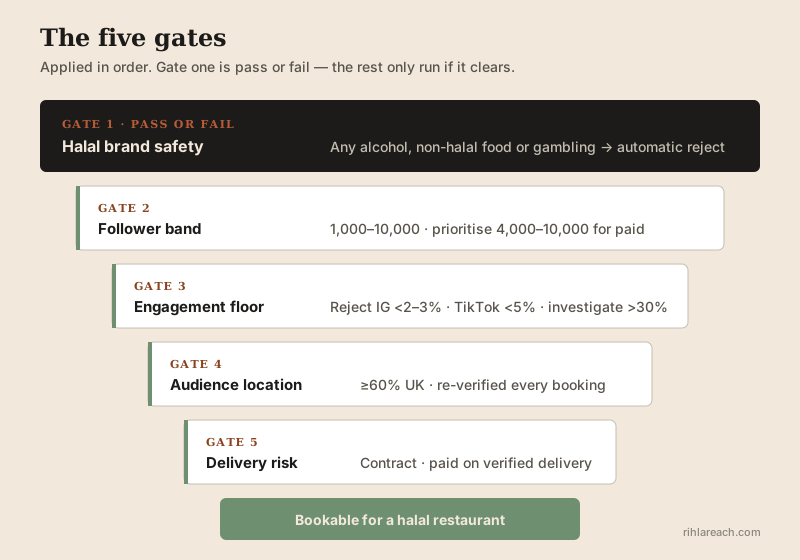
Halal brand safety: scroll the whole recent feed
Open the creator’s last thirty to fifty posts and look for alcohol, non-halal food, and gambling content. Not just in the food posts, but in the birthday photos, the holiday content, the stories they have saved to highlights.
Treat this as an automatic reject, not a judgement call. The moment it becomes case-by-case, it stops being a standard. A restaurant that has spent years protecting a reputation does not want to be two swipes away from a wine glass on the same profile, and the audience making that association is exactly the audience the restaurant most cares about.
The awkward version of this check is the creator who is otherwise perfect (great engagement, local audience, genuinely good food photography) but with one non-halal review from eight months ago. It is still a reject. The whole value of a specialist roster is that it holds when it is inconvenient.
Follower band: smaller is usually better
For a single-location restaurant, target the 1,000–10,000 range. This is the nano tier, and it is counter-intuitively the right one: reach outside your own city is mostly wasted spend, and the larger an account gets, the more geographically scattered its audience becomes.
Five hundred people who can drive to you on a Friday are worth more than fifty thousand who cannot. Within that band, 4,000–10,000 tends to be the sweet spot for paid bookings: enough reach to matter, small enough that the audience is still genuinely local and the creator still replies to comments.
Engagement rate, and the trap of a number that looks too good
Engagement rate is followers divided into the average interactions per post. It is the single most useful number on a profile, and the platforms behave very differently:
Instagram: reject below 2–3%. A healthy working range is 3–8%.
TikTok: the whole scale sits higher. Reject below 5%, and expect 8–15% from a genuinely engaged nano account.
Those floors are deliberately set below average rather than at it. External 2026 benchmark reporting puts Instagram nano-influencers at roughly 3.5–6% and TikTok nano accounts around 9–15%. The floor exists to catch dead accounts, not to demand exceptional ones.
The counter-intuitive part: anything above roughly 30% should be investigated, not celebrated. Genuine nano accounts rarely sustain that. The usual explanations are bought engagement, an engagement pod, or one freak viral post dragging the average up. Check whether engagement is spread evenly across recent posts or concentrated in a single outlier, and whether the comments say anything specific about the food or are generic emoji strings from the same handful of accounts.
Audience location: ask for the screenshot
A creator based in your city does not necessarily have an audience in your city. Food content travels, and plenty of UK-based creators have audiences that are majority overseas, which is flattering for them and useless for a restaurant selling tables.
Set a floor of at least 60% UK audience, and for a local campaign look for concentration in the restaurant’s own city on top of that. You cannot see this from outside: ask the creator for a screenshot of their own audience insights.
Re-check it every booking, not once. Audience composition shifts, sometimes sharply, if a creator has a post travel outside their normal reach. A check from six months ago is not evidence about today.
Delivery risk: the check nobody runs
The first four checks tell you whether a creator is worth booking. This one tells you whether the content will actually exist.
Non-delivery on gifted arrangements is common, and better documented than most restaurants realise. In Modash’s 2026 gifting survey of 74 marketers, 90.5% said creators ghost gifting campaigns more often than any other kind of collaboration, and posting was reported as more consistent under barter deals than under no-strings gifting, 50% against 43.8%. Those last two figures are marketers’ reported experience rather than a measured posting rate, so treat them as direction, not a number to budget against. This is the single most common complaint restaurants have about influencer marketing, and it is usually described as bad luck when it is really a structural problem: an informal arrangement with no contract and no consequence gives the creator nothing to lose by not posting.
The fix is unglamorous. A written agreement covering deliverables, deadline, platform and usage rights; and payment tied to verified delivery rather than paid upfront or assumed against a free meal. Do that and the no-show problem largely disappears, because there is now something at stake.
When a free meal becomes an advert
This part catches out a lot of restaurants who assume the rules only apply to paid campaigns. They do not.
If you give a creator something of value (a comped meal counts) and you have any editorial control or expectation over what they post, the content is advertising and must be labelled as such. “We did not pay them, we just fed them” is not an exemption.
The UK requirements, from the ASA’s own guidance and the joint CMA and ASA guidance for creators, are that the disclosure must be immediate, prominent and easy to understand, and obvious as soon as someone engages with the content, not buried at the end of a caption or hidden in a block of hashtags. Labels along the lines of “ad”, “advert” or “paid partnership” are generally acceptable.
A common misconception worth correcting: the hash is not actually required. The ASA states that it is not necessary to use a ‘#’ as part of the label, provided the label is prominent and clearly separate from other content. “Ad” on its own, placed where it is immediately visible, does the job. What fails is a label that is small, late, or mixed into a hashtag pile.
Responsibility sits with both parties. The advertiser is responsible for proper disclosure as well as the creator, and that responsibility cannot be contracted away. An agency can build compliant disclosure into every brief and every contract, and should, but no agency can absorb your responsibility for it. If one tells you they can, that is a reason for caution rather than comfort.
This is a plain-language summary for restaurant owners, not legal advice. For a specific campaign, check the current ASA and CMA guidance directly or take professional advice.
Red flags worth a second look
Follower count far ahead of engagement. Thirty thousand followers and forty likes a post is the classic bought-audience signature.
Comments that never mention the food. Generic praise and emoji from the same rotating handful of accounts usually means a pod.
Sudden follower jumps. Organic nano growth is gradual. A vertical step in the graph is bought or a one-off viral spike, and the two behave very differently afterwards.
Every post is an ad. A feed that is wall-to-wall brand collaborations has an audience trained to scroll past them.
Reluctance to share audience insights. Occasionally shyness. More often the numbers do not support the pitch.
Common questions
What engagement rate should a halal food creator have?
On Instagram, treat anything below 2–3% as a reject and 3–8% as a healthy working range. On TikTok the whole scale sits higher, so reject below 5% and expect 8–15% from a genuinely engaged nano account. External 2026 benchmark reporting puts Instagram nano-influencers around 3.5–6% and TikTok nano accounts around 9–15%, so these floors sit deliberately below average rather than at it. The floor is there to catch dead accounts, not to demand exceptional ones.
Is a very high engagement rate a good sign?
Not automatically. Anything above roughly 30% should be investigated rather than celebrated. Genuine nano accounts rarely sustain that, and the usual explanations are bought engagement, engagement pods, or a single freak viral post skewing the average. Check whether the engagement is spread evenly across recent posts or concentrated in one, and whether comments are specific or generic emoji strings.
Does a gifted meal count as an advert under UK rules?
Usually yes. If the restaurant gives something of value and has any editorial control or expectation over what gets posted, the content is an ad and must be labelled as such. The ASA requires the label to be immediate, prominent and upfront rather than buried in a caption or hashtag block. Notably, the ASA says the hash itself is not required: ‘ad’ works as well as ‘#ad’, provided the label is prominent and clearly separate from other content.
Who is responsible if an influencer post is not disclosed properly?
Both the creator and the advertiser. Responsibility for proper disclosure sits with the brand as well as the influencer, and it cannot be contracted away. An agency can build disclosure into every brief and contract, but no agency can absorb the restaurant’s own responsibility. Treat any agency that claims otherwise with caution.
How many creators actually pass vetting?
Far fewer than a sourcing list suggests. Once brand safety, follower band, engagement floor and audience location are all applied, most handles that look usable on first glance are rejected. Sourcing volume is easy; usable supply is the scarce thing, and in a single city the realistic working bench is typically a few dozen creators rather than hundreds.
Sources
Every external figure on this page, with the source it came from. Last checked 2026-08-27.
- Engagement Rates by Follower Tier (2026), Nowadays Media.Supports: the external nano benchmarks quoted above: Instagram 3.5–6%, TikTok 9–15%.
- The State of Influencer Gifting in 2026 [Survey Data], Modash, 22 May 2026, survey of 74 marketers.Supports: the 90.5% ghosting figure and the 50% against 43.8% barter-versus-gifting posting comparison.
Would rather not run these checks yourself?
That is the job. We run all five on every creator before they are booked for your restaurant, and you see the reasoning, not just a name. See how it works for halal restaurants in Birmingham, read what this costs in the UK, or read the standard we hold.
See if I can help